
When temperatures drop across the Front Range and the snow starts piling up on the peaks, Southern Colorado homeowners do the exact same thing: seal the house tight. Windows stay latched, storm doors stay shut, and the furnace runs overtime to keep the chill out.
Winter is actually one of the best times of year to tackle interior painting projects: refreshing bedrooms, updating living rooms, or transforming kitchen cabinets while spending more time indoors. However, painting inside a tightly sealed winter home brings up a critical question that many homeowners overlook until the first can of paint is cracked open: What exactly are you breathing in?
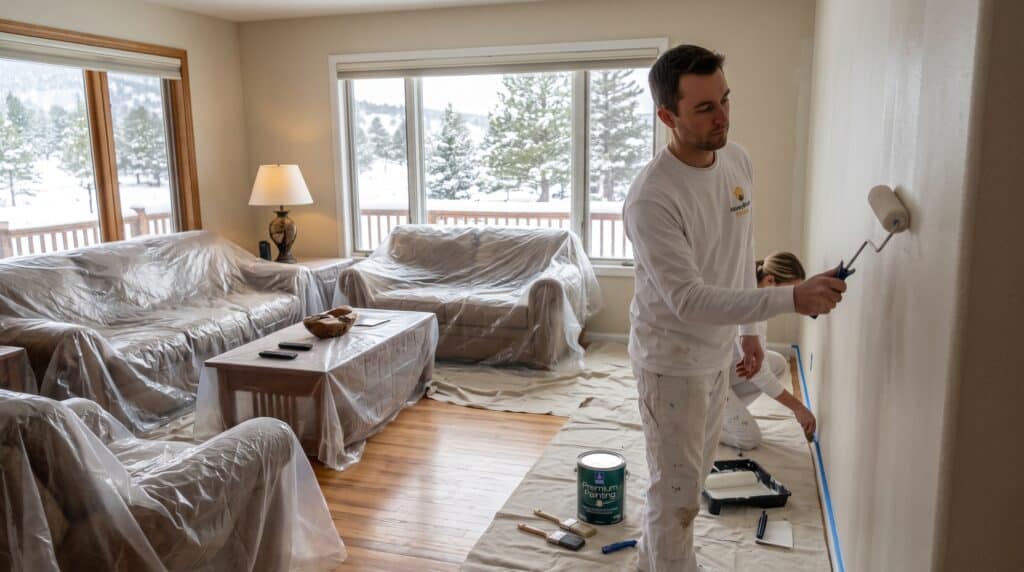
At HoneyBrush Painting, a fresh coat of paint should transform your space without forcing your family to endure lingering chemical odors or headaches. Protecting your home’s indoor air quality during the colder months requires understanding Low-VOC and Zero-VOC paints, and knowing how we approach winter interior projects The HoneyBrush Way.
VOCs stand for Volatile Organic Compounds. They are carbon-based chemicals used as solvents in traditional paints to keep the liquid stable in the can and help it flow smoothly onto your walls. As the paint dries and cures, those compounds evaporate into the air at room temperature in a process called off-gassing.
That sharp, unmistakable “new paint smell” isn’t the scent of cleanliness. It is the smell of airborne chemical solvents releasing into your living space.
During a warm Southern Colorado summer, you can throw open every window in the house, turn on a few box fans, and flush those vapors outside in a day or two. In the middle of winter, opening your windows for 48 hours isn’t an option. Because modern homes are heavily insulated and sealed to prevent heat loss, airborne VOCs become trapped inside. Instead of dissipating outdoors, they recirculate through your HVAC system, leading to indoor air pollution levels that can be several times higher than the air outside.
Short-term exposure to trapped VOCs can trigger a range of uncomfortable symptoms, especially when you are spending long winter evenings indoors:
Even worse, conventional high-VOC paints don’t stop off-gassing the moment the walls feel dry to the touch. While the strongest fumes peak in the first 24 hours, traditional formulas can continue releasing measurable emissions for weeks or even months as the resin fully cures.
Not all “eco-friendly” paint labels mean the same thing. Knowing the numbers behind the labels helps you make the smartest choice for your home:
One industry secret that catches many homeowners, and even some painters, off guard is that the “Zero-VOC” rating on a paint can only applies to the untinted white base.
If you pick a Zero-VOC base paint at a big-box store, and the clerk injects conventional chemical colorants into the can to create a deep navy blue or rich forest green, the VOC content can spike from under 5 g/L all the way up to 50–150 g/L. Suddenly, your “Zero-VOC” nursery or primary bedroom paint is off-gassing just like a standard formula.
At HoneyBrush Painting, we exclusively use Sherwin-Williams premium coatings, including Duration Home®, Emerald®, and Emerald® Symmetry™. Not only are these premium interior lines formulated with Zero-VOC technology and GREENGUARD Gold certifications for low chemical emissions, but Sherwin-Williams also uses ColorCast Ecotoner® colorants. Unlike traditional tints, these advanced colorants do not add any VOCs to the paint when mixed, meaning even your boldest, darkest winter accent wall stays truly Zero-VOC.
Ten or fifteen years ago, choosing a Zero-VOC paint meant making a frustrating trade-off. Early eco-friendly formulas were notorious for being thin, streaky, slow to dry, and easy to scuff.
In modern resin chemistry, that compromise no longer exists. Premium Zero-VOC coatings like Sherwin-Williams Emerald® and Duration Home® match or outperform conventional paints across every metric:
Choosing the right can of paint is only half the battle. Who applies it, and how they treat your home while the doors are shut against the winter cold, makes all the difference. Every winter interior project follows The HoneyBrush Way:
You don’t have to wait until spring to transform your living room, brighten up a dark hallway, or give your bedrooms a fresh look. With true Zero-VOC Sherwin-Williams coatings and our in-house Southern Colorado crew, you can enjoy newly painted walls tonight, without cracking a window in freezing weather.
Contact HoneyBrush Painting today at HoneyBrushPainting.com to schedule your free estimate and complimentary color consultation!
HoneyBrush handled my basement remodel with ease and got me the home I deserve. Cannot recommend enough!